
Assembly Line Layout Design
Assembly line layout design has a direct impact on productivity, operator movement and material flow. A well-designed layout allows components to move efficiently through the production process while ensuring operators have the materials and tools they need within easy reach.
Many production areas evolve over time without a clear layout strategy. Workstations are added where space allows, material storage grows around the line, and operators begin walking longer distances to retrieve parts and tools.
These small inefficiencies accumulate quickly and can significantly reduce output and increase labour cost.
The ATC Design Configurator allows engineers and manufacturing teams to design modular workstations, flow racks and material supply systems that support better production line layouts.
What Is Assembly Line Layout Design?
Assembly line layout design is the process of arranging workstations, material supply and operator positions so that products move through production efficiently and with minimal wasted motion.
In Lean manufacturing, layout design focuses on supporting flow, reducing walking distance and ensuring materials are presented at the point of use.
Effective layouts help support:
- reduced operator movement
- improved material presentation
- smoother product flow
- better use of floor space
- faster replenishment
- clearer visual organisation
Common Problems in Assembly Line Layouts
Many production lines develop layout problems as processes change or volumes increase.
Common issues include:
- operators walking long distances to collect parts
- materials stored away from the workstation
- poor FIFO control
- crowded work areas
- inefficient workstation positioning
Addressing these issues often starts with redesigning workstation layouts and improving point-of-use material presentation.
Estimate the Cost of Operator Walking
Before redesigning a production layout, it can be useful to estimate how much time may be lost when operators repeatedly leave their workstation to collect parts or tools.
Assembly Walking Waste Calculator
Assumptions used in this estimate:
• 8 hour shift
• 240 working days per year
• Constant walking frequency across the shift
Improving Production Layout with Point-of-Use Supply
One of the most effective improvements in assembly line layout design is moving materials closer to the operator. Flow racks, material supply trolleys and modular workstations allow components to be presented directly within the operator’s reach zone.
This reduces unnecessary walking, improves ergonomics and allows replenishment to happen more smoothly.
Modular systems also allow layouts to evolve as production requirements change.
Design Workstations and Material Supply Systems
The ATC Design Configurator allows engineers to quickly configure modular workstation frames, flow racks and material supply systems that support better production layouts.
- assembly workstations
- flow rack material supply
- water spider carts
- point-of-use supply trolleys
- modular aluminium profile structures
Open the Workstation Configurator
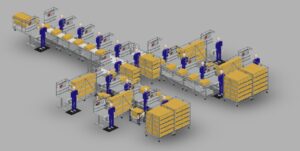
Example: Assembly Line with Point-of-Use Flow Rack
In this example, a modular flow rack supplies components directly beside the workstation. This reduces operator walking and improves the flow of materials through the assembly process.
Need Help Designing a Production Layout?
If you are planning a new assembly line or redesigning an existing production area, the ATC engineering team can help develop workstation layouts and material supply systems suited to your process.

Frequent Questions
Assembly line layout design involves arranging workstations, material supply, and operator positions to facilitate efficient product movement and minimize wasted motion.
Effective layouts reduce walking distances, improve ergonomics, and streamline material flow, thereby increasing productivity and reducing labor costs.
The ATC Workspace Configurator enables the creation of modular workstations, flow racks, and material supply systems to optimize production layouts.
Layout design in lean manufacturing supports flow, reduces unnecessary movement, and ensures materials are available at the point of use, enhancing overall efficiency.
Problems include increased walking distances, inefficient material presentation, and difficulty adapting to process changes or increased production volumes.
Layouts can be enhanced by relocating materials closer to operators, implementing modular systems, and redesigning workstations to support changing production needs.